
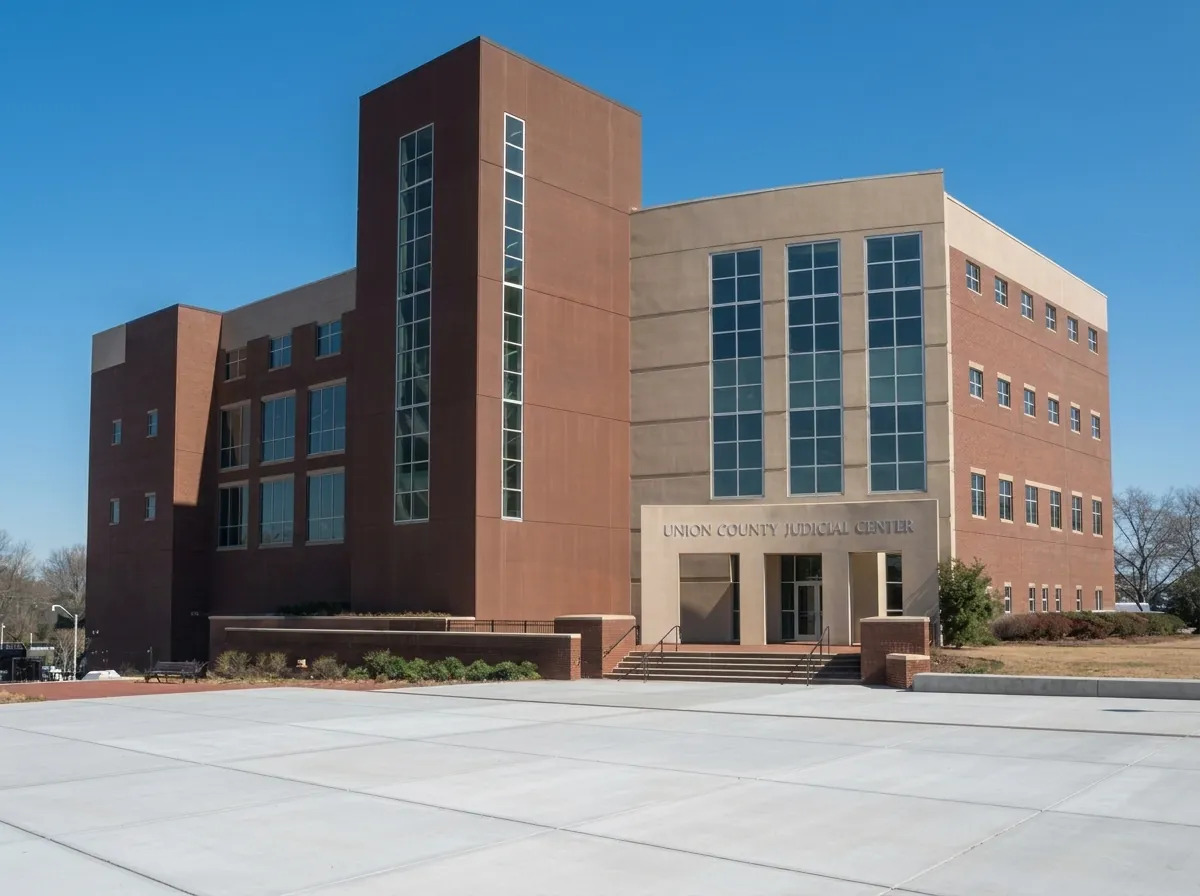
Court records of Union County, North Carolina, are maintained by the Clerk of the District Court and are accessible through online tools, official court portals, and directly at the clerk's office. UnionNCCourt.us will help you find public information about court records in this county. Additionally, you can use the North Carolina Judicial Branch portal for Union County, the court records obtaining page, or visit the clerk's office in person.
Union Court System Overview
Union County is part of the 20th Judicial District (Judicial District 20B) of North Carolina. The county's court system consists of two main levels — Superior Court and District Court, which handle criminal, civil, and family cases according to jurisdiction. Magistrates work at the District Court and perform limited judicial functions: issuing warrants, setting bail, and hearing small claims. Judicial District 20B exclusively serves Union County.
The clerk's office typically operates Monday through Friday, from 8:00 AM to 5:00 PM. You can verify the hours of operation and contact details on the official Union County page on the judicial branch's website.
Courts Serving Union
Residents of Union County are served by several courts of different jurisdictional levels:
State Courts
Union County Superior Court
Union County District Court
Magistrate's Office — Union County
Federal Court
U.S. District Court for the Western District of North Carolina (Charlotte Division)
U.S. Bankruptcy Court — Western District of North Carolina
Municipal Courts
In North Carolina, municipal courts do not function separately. Cases involving violations of city ordinances are heard by the county's District Court.
What Types of Cases Union Courts Hear
Union County courts hear a wide range of cases. Here are the main categories:
- Criminal cases: felonies, misdemeanors, infractions
- Civil cases: large claims, small claims
- Family law: divorce, child custody, alimony, protective orders
- Probate cases: estate management, guardianship, conservatorship
- Juvenile cases: juvenile offenses, child protection, adoption
- Traffic violations: fines, DWI/DUI
Details on each category are in the following sections.
District Court Cases in Union
The Union County District Court hears misdemeanors, infractions, family cases (divorce, custody, alimony), juvenile cases, and civil claims up to $25,000. Additionally, this court conducts preliminary hearings in felony cases before transferring them to the Superior Court. Cases are initiated by filing claims, complaints, or petitions with the clerk's office. A District Court judge is administratively assigned according to the case category. Preliminary hearings, party conferences, and court sessions are held at the courthouse on Main Street in Monroe.
Magistrate Court Cases in Union
Magistrates in Union County are judicial officers at the District Court with limited jurisdiction. They perform the following functions:
- Issuing arrest and search warrants
- Setting bail conditions at initial detention
- Hearing small claims cases up to $10,000
- Administering oaths and certifying documents
- Conducting marriage ceremonies
Magistrates do not conduct full criminal hearings — these cases are transferred to the District Court or Superior Court. Small claims are filed directly with the magistrate; the procedure is simplified and does not require an attorney. According to North Carolina law, the limit for small claims is $10,000.
Family Law, Probate, and Juvenile Matters in Union
Family Law
Cases involving divorce, custody, alimony, paternity, and protective orders (domestic violence protective orders) are heard by the District Court. Divorce certificates can be obtained from the state's vital records department or the county clerk where the case was filed. To file for divorce in North Carolina, the spouses must have lived separately for at least one year.
Probate Cases
The clerk's office of the Superior Court performs probate court functions. The clerk approves wills, appoints executors and guardians, and oversees the distribution of deceased persons' estates. Guardianship and conservatorship cases for incapacitated individuals also fall under the clerk's jurisdiction.
Juvenile Cases
The District Court hears juvenile cases: offenses, child protective cases, and termination of parental rights. Juvenile case records are confidential according to state law. Access is restricted and granted only to authorized individuals.
How Cases Move Through the Union Court System
- Case initiation. A criminal case begins with the filing of a complaint or issuance of a warrant; a civil case starts with the filing of a complaint or petition with the clerk's office.
- Judge assignment. The clerk registers the case and assigns a number. A judge is appointed according to the type of case and the schedule of hearings.
- Initial hearings. In criminal cases — the first appearance or arraignment. In civil cases — a planning conference.
- Pre-trial phase. Parties exchange evidence (discovery), file motions. In criminal cases, plea negotiations may occur.
- Trial or resolution. The case concludes with a jury verdict, plea agreement, settlement, or default judgment.
- Post-judgment. Sentencing, filing an appeal, or enforcing the judgment. Appeals from the District Court are directed to the Superior Court, and from the Superior Court to the Court of Appeals.
Court Administration, Local Rules, and Public Access in Union
The administrative judge of the 20th Judicial District (District 20B) oversees the general management of Union County courts. The court administrator coordinates the daily operations of the office, the schedule of hearings, and public interaction.
Union County local rules and forms are published on the North Carolina Judicial Branch website. It includes Superior Court rules, bail policy, and other local regulations.
According to North Carolina's Public Records Act and the Open Government Guide, most court records are publicly accessible. Exceptions include juvenile cases, sealed records, and cases where the court has issued an order restricting access. Paper cases can be viewed by visiting the clerk's office in the county where the case is registered.
Court sessions in Union County are generally open to the public. Some hearings may be held remotely — check this possibility with the clerk's office.
Court Records and Related Court Resources in Union
- Online case search. The North Carolina Judicial Branch portal allows you to search court records by name, case number, or county.
- Obtaining court records. The Court Records section contains instructions on checking criminal history, obtaining copies, and expungement.
- State public records. The NC DAC public records portal provides access to various categories of records, including criminal and civil cases.
- Union County inmate search. Inmate Inquiry on the county sheriff's website allows you to check who is currently held in the county jail.
- Arrests and incidents. Arrest and incident search and the daily bulletin of the sheriff are timely sources of information about recent events.
- Wanted persons list. The Wanted List of the Union County sheriff publishes data on individuals who are wanted.
- State offender search. The NC Department of Adult Correction Offender Search is a database of inmates in state facilities and individuals on probation.
- Sex offender registry. The North Carolina state registry is available on the NC SBI (State Bureau of Investigation) website.
- Legal aid and resources. The Legal & Justice page on NC.gov aggregates links to criminal records, victim services, and the court system.
- Local forms and rules. Union County forms and local rules are available for download on the judicial branch's website.